The Art of Projecting Concentrated Nondispersive Energy Through the Natural Media Pdf
http://www.tfcbooks.com/tesla/1935-00-00.htm
http://www.teslaradio.com/pages/teleforce.htm
Circa May 16, 1935
Briefly Exposed past Nikola Tesla
The advances described are the outcome of my enquiry carried on for many years with the chief object of transmitting electrical free energy to neat distances. The showtime important applied realization of these efforts was the alternating current power system now in universal employ. I then turned my attention to wireless transmission and was fortunate enough to achieve similar success in this fruitful field, my discoveries and inventions being employed throughout the world. In the course of this work, I mastered the technique of high potentials sufficiently for enabling me to construct and operate, in 1899, a wireless transmitter developing up to twenty million volts. Some time before I contemplated the possibility of transmitting such high tension currents over a narrow axle of radiant free energy ionizing the air and rendering it, in measure, conductive. Afterward preliminary laboratory experiments, I made tests on a large scale with the transmitter referred to and a beam of ultra-violet rays of not bad energy in an try to conduct the current to the high rarefied strata of the air and thus create an auroral such as might be utilized for illumination, specially of oceans at nighttime. I plant that there was some virtue in the principal but the results did non justify the hope of of import applied applications although, some years afterwards, several inventors claimed to accept produced a "death ray" in this mode. While the published reports to this effect were entirely unfounded, I believe that with the new transmitter to be built, this and many other wonders will be achieved. Much time was devoted past me to the transmission of radiant energy, in various forms, by reflectors and I perfected means for increasing enormously the intensity of the effects, only was baffled in all my efforts to materially reduce dispersion and became fully convinced that this handicap could only be overcome by conveying the power through the medium of small particles projected, at prodigious velocity, from the transmitter. Electro-static repulsion was the only means to this end and apparatus of stupendous force would have to be developed, only granted that sufficient speed and energy could be realized with a single row of minute bodies then at that place would be no dispersion whatever even at nifty distance. Since the cross department of the carriers might be reduced to almost microscopic dimensions an immense concentration of energy, irrespective of altitude, could be attained.
When I undertook to carry out this plan in practice, the difficulties seemed insurmountable. In the first place, a closed vacuum tube could non be employed as no window could withstand the force of the touch on. This made it admittedly necessary to project the particles in free air which meant that each could concur but an insignificant charge. Thus, no matter how high the potential of the terminal, the force of repulsion would be necessarily too small for the purpose contemplated. . . . But by the awarding of my discoveries and inventions it is possible to increment the force of repulsion more than a million times and what was heretofore incommunicable, is rendered easy of achievement. The successful carrying out of the plan involves a number of more or less of import improvements simply the principal among these include the following:
- A new form of high vacuum tube open to the atmosphere.
- Provisions for imparting to a minute particle an extremely high charge.
- A new terminal of relatively small dimensions and enormous potential.
- An electro-static generator on a new principle and of very swell power.
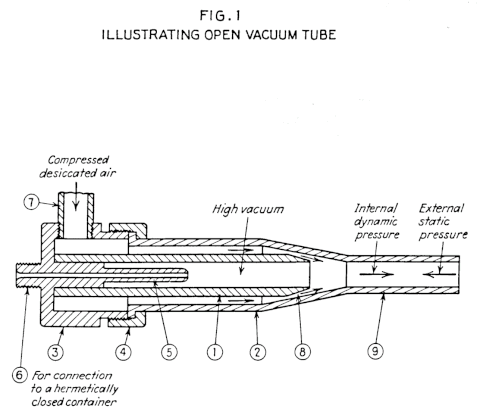
These devices and methods of operation volition exist explained by reference to the attached drawings in which Fig. 1 and Fig. ii represent forms of the new open up tube.
In Fig. 1, the device consists of an inner cylindrical conduit i, cemented to a metallic socket 3, and an outer conduit 2, which is tightly screwed to the socket past a nut 4, and has on the open side a taper with a cylindrical finish ix, of the aforementioned within diameter every bit conduit ane. The socket 3, is bored out to provide a large chamber around the inner conduit and carries a pipe 7, through which thoroughly desiccated air or other gas under suitable force per unit area is supplied. The open end of the inner and the tapering role of the outer conduit are footing to form an expanding nozzle 8, through which the air escapes into the atmosphere thereby creating a high vacuum in the inner conduit. The socket iii has a modest primal hole and is provided with an inside extension 5, and a threaded outside projection vi, the latter serving for connection to a container supplying automatically suitable particles or material for same while the former fulfill the purpose of charging them as they sally from the hole. The conduit 1 and two, may be made of fused quartz, pyrex glass or other refractory material and information technology is obviously desirable that all the parts of the appliance take small and well-nigh equal coefficients of thermal expansion especially when the working medium, which might also be superheated steam is at an elevated temperature.
Information technology volition be observed that in this tube I do away with the solid wall or window indispensable in all types heretofore employed, producing the high vacuum required and preventing the inrush of the air by a gaseous jet of high velocity. Evidently, to secure this issue, the dynamic pressure level of the jet must be at least equal to the external static force per unit area.
Expressed in symbols:
Viiwestward/2g = P
Assuming equality:
V = √2g P/w
in which equation V is the speed of the jet at its entrance to channel 8 in meters, g the dispatch of gravity likewise in meters, P the external pressure in kilograms per square meter and w the normal weight of the air in kilograms per cubic meter. Now
g = 9.81 meters
P = 10332.9 kilograms
westward = 1.2929 kilograms
These values give
Five = 396 meters
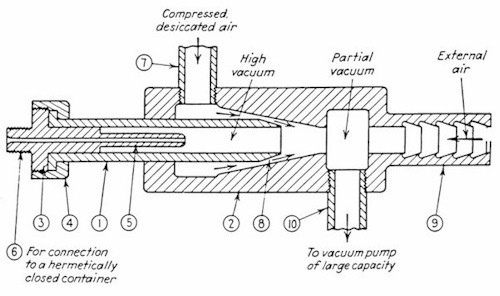
Some allowance should be made for the frictional loss in the nozzle and the outlet channel and also for the deflection of the jet. For most purposes, the velocity need not exist much greater, but as the degree of rarefaction depends on the square of V, it is desirable to obtain equally high a value as practicable. Unremarkably, vacuums obtained by a mercury vapor pump are considered very high. In those, the velocity is only 280 meters per second but the vapor is 6.9 times heavier than air.
Therefore to get the same vacuum in the air jet, its speed should be 280 x [six.nine]1/two = 735 meters. With a working medium at high temperature and pressure, both within practicable limits, this value can be attained and even exceeded. Thus, a gaseous jet of very high velocity affords a means for closing the end of the tube, more perfectly than any window that can exist fabricated while at the same fourth dimension permitting and facilitating the leave of the particles. Referring to fig. 2., it shows schematically a modified course of my tube intended for various scientific and applied uses when it may be preferable or necessary not to discharge the jet through the open up end. The construction of the device volition be easily understood in view of the foregoing clarification like parts being similarly designated. A cylindrical conduit 1, is provided equally in fig. 1, simply the outer cone is replaced by a block 2, of lava or other insulating material shaped as indicated and firmly cemented to the conduit 1, which is hermetically joined by a nut 4, to a metal plug iii, having a cardinal hole, and extensions 3 and 6, serving the purpose stated in a higher place. The working fluid, as compressed desiccated air, is supplied by means of a piping vii, to a large annular space around conduit ane, and escapes through an expanding nozzle eight, formed by the tapering part of the block and the end of the conduit, into a chamber connected by a piping 10, to a vacuum pump of big chapters - non shown on the drawing - for carrying off non only the air issuing from the nozzle just besides that rushing in from the outside through the open cease 9. In order to minimize the volume of the latter, I avail myself of an invention of mine known equally the "valvular conduit" by providing the wall of the open up end ix, with recesses as indicated giving rising to whirls and eddies which use upwardly some of the energy of the stream and reduce its velocity. In this way, a pressure of about 100 millimeters of mercury can exist readily maintained in the chamber increasing profoundly the expansion ration of the air and its speed through the nozzle.
It is hardly necessary to remark that my open vacuum tubes crave mechanical power for performance which may range from 10 to 20 h.p., but this drawback is insignificant when because the important advantages they offering and I anticipate that they will be extensively employed.
It remains to be explained how such a tube is utilized for imparting to a particle to be projected a very great charge. Imagine that the pocket-size spherical body be placed in a nearly perfect vacuum and electrically continued to the large sphere forming the high potential final of the transmitter. By virtue of the connection, the small sphere will then exist at the potential of the big one no matter what its altitude from the same but the quantity of electricity stored on the pocket-sized sphere volition vary profoundly with the distance and be proportionate to the difference of its potential and that of the adjacent medium. If the small-scale sphere is very close to the big one, this difference will be insignificant and so to the charge; but if the small sphere is at a great distance from the large 1 where the potential imparted by the same to the medium approximates naught, the quantity of electricity stored on the small one will be relatively enormous and equal to Qr/R. To illustrate, if r = 1/100 e.s. and R = chiliad e.s. and Q = 108 e.s. units, every bit earlier assumed, and so Q =1000 eastward.s. units which is a hundred thousand times more than previously obtainable. At a distance 2R from the center of the terminal, at which the difference between the potential of the small-scale sphere and the adjacent medium will exist half of the total, or 15,000,000 volts, Q will be 500 e.southward. units and from theoretical considerations, it appears that the all-time results will be secured if the particle is charged in high vacuum at that distance. Information technology can exist achieved all the more easily the smaller the radius of the terminal and this is i of the reasons why my improvement, illustrated in Fig. 3, is of corking practical importance.
![FIG. 3 NEW TERMINAL FOR EXCEEDINGLY HIGH POTENTIALS CONSISTING OF SPHERICAL FRAME ATTACHMENTS [See Fig. 4 for TERMINAL.]](https://image.jimcdn.com/app/cms/image/transf/none/path/s40c423127565d23a/image/i2786baa11c351c57/version/1360552484/image.gif)
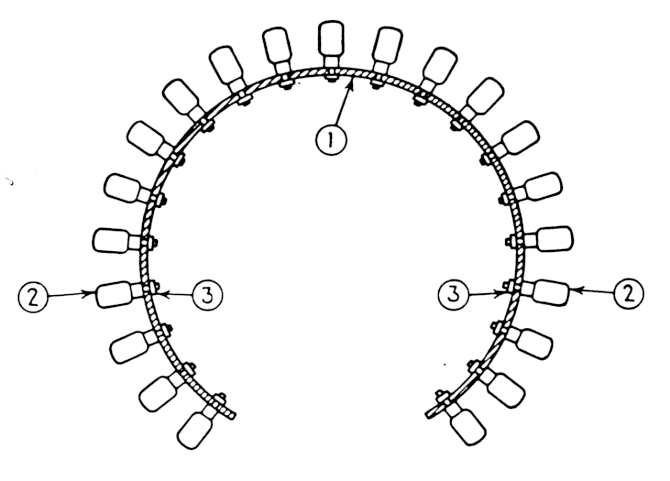
Every bit volition appear from the inspection of the drawing, the spherical frame of the terminal is equipped with devices, one of which is shown in the enlarged view below and comprises a bulb ii, of glass or other insulating material and an electrode of thin canvas suitable rounded. The latter is joined past a supporting wire to a metallic socket adjusted for fastening to the frame 1, by means of nut three. The seedling is exhausted to the very highest vacuum obtainable and the electrode can be charged to an immense density. Thus, it is made possible to heighten the potential of the terminal to whatever value desired, and so to speak, without limit, and the usual losses are avoided. I am confident that every bit much as one hundred meg volts will be reached with such a transmitter providing a tool on costive value for practical purposes as well as scientific research.
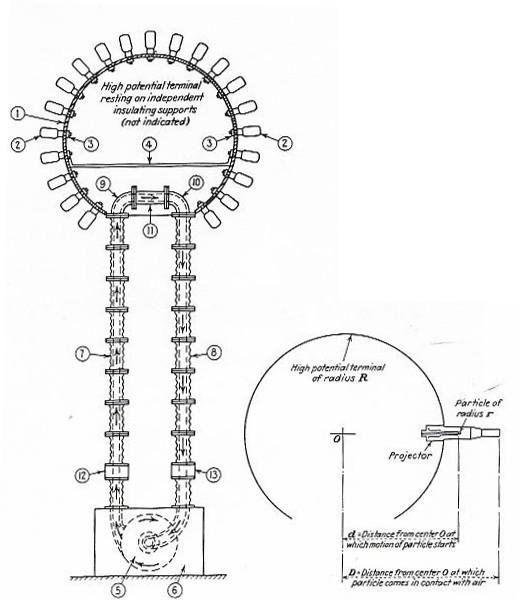
Maybe the most important of these inventions is the new high potential electro-static generator, schematically represented in Fig. four, which is provided with my improved concluding consisting of a spherical metallic frame ane, with attachments 2, adjusted to be fastened to the former by nuts three, as higher up described. The terminal has a platform 4, in the interior of the frame intended for supporting mechanism, instruments and observers, and is carried to a suitable elevation on insulating columns omitted from the drawing for the sake of simplicity. To energize the concluding, air under pressure is driven at high speed through a hermetically closed aqueduct comprising a turbo compressor v, with intake and outlet connections, conduits 7 and viii, special fittings nine and 10,and a short pipe xi. The conduits 7 and 8, are preferably equanimous of pieces of glazed porcelain bolted tightly together, the joints being fabricated airtight by suitable packing and are corrugated on the outside to minimize electrical leakage. The fittings 9 and 10 and pipe 11, may besides exist of the same kind of material. The air before entering and after leaving the compressor, too as all apparatus within the airtight enclosure 6, is effectively cooled and maintained at a constant temperature by means as usually employed which was not thought necessary to illustrate. The operation of the machine will exist understood most readily by likening the moving column of air to a running chugalug. When the air, leaving the compressor, reaches the device 12, containing discharge points electrified past a straight current of high tension, it is ionized and the accuse imparted to it is carried upward to the special fitting nine, where it is drawn off by sucking points and charges the last. On the return to the compressor the air passes through special fitting ten, where it receives electricity of the contrary sign conveying information technology to the device 13, and from there to the ground. These actions are repeated with neat rapidity. The generator tin be made self-exciting past suitable connections. For several reasons, I estimate that a machine every bit described volition have an output of many times greater than a belt generator of the same size and, besides, it has several other important construction and operative advantages.
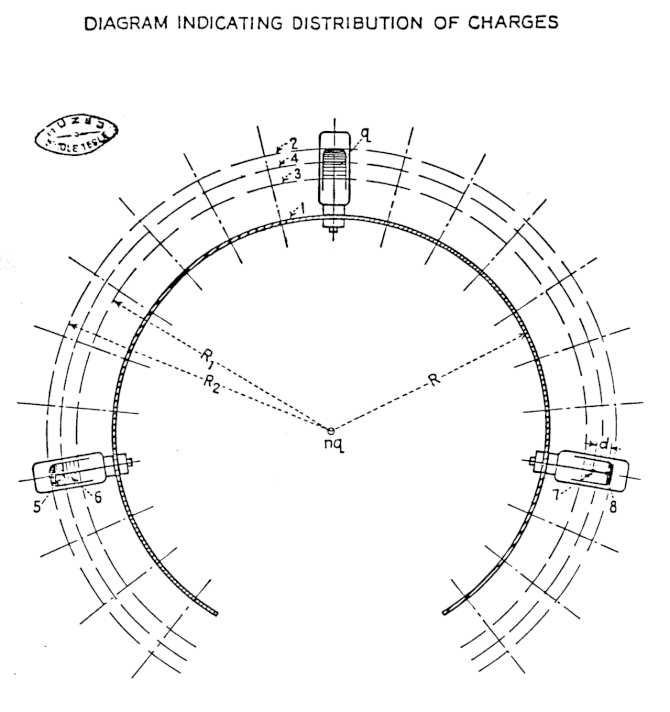
To give an guess guess of performance, reference is made to diagram in Fig. five, representing a spherical last and an open up vacuum tube for projecting particles. Suppose that d be the distance from the center o at which a particle of radius r = one/100 c.m. is charged in vacuum to the potential of the concluding, as before explained, and that D is the altitude from center O at which the particle leaves the vacuous space, then, in passing through the distance D - d it will be accelerated to a velocity:
V1 = √2Qq (D-d) / md D centimeters per second
In its transit from distance D to a very much greater distance an additional velocity of:
V2 = √2Qq' / one thousand D centimeters per 2nd
q' being, theoretically, smaller than q. But I have found that although the particle in contact with air is neutralized rapidly yet, on account of its small surface, magnitude of the charge and prodigious speed, a very great distance is traversed without material reduction of the charge so that, without appreciable error, q' may be considered equal to q. Thus, the total velocity attained volition be:
V = 51+Vtwo = √2Qq (D-d) / md D + √2Qq' / m D centimeters per second
in which expression Q and q are in eastward.s. units, D and d in centimeters and m the mass of the particle in grams. But the calculation may be simplified, for if the charge is virtually constant through a great distance, the velocity finally attained will be:
Five = √2Qq / doc centimeters per second
Assume now that the final is equivalent to a sphere of radius R = 250 centimeters which heretofore could but be charged to a potential of 100 x 250 = 25,000 e.s. units or 7,500,000 volts simply, by taking advantage of my improvements, tin can be readily charged to 2 ten 105 e.south. units or half dozen x 107 volts in which case the quantity of electricity stored will be Q = 2 ten 105 x 250 = v x 107 eastward.s. units. If, for best effect, the particle is charged in vacuum at a distance d = 2R = 500 centimeters where the deviation between its potential and adjacent medium is 3 x 10⁷ volts or 105 e.southward. units, and so q/r = 105 and q = 105 = chiliad e.s. units. The particle will have a volume of 4TT/3 x 106 cubic centimeters and if it exist tungsten, it will weigh about 4TT x 18/3 10 106 = 7686/1011 gram. Substituting these values:
V = √2 x 5 ten 107 x 1000 x 1011 / 1000 ten 7686 x 500 = 1,613,000 centimeters or 16,130 meters per second.
This finding may be checked by using the relation between the joule'due south equivalent and the kinetic energy. Here the joules are 3 10 107 x yard / 3 x 109 = 10 and approximately equal to 106 gram-centimeters. Consequently,
mVii / 2 = ten6
Fivetwo = 2 ten tenhalf-dozen x 1011 / 7686 and
V = 1,613,000 centimeters or xvi,130 meters
every bit found above by my formula which is always applicative while the latter rule is not.
Since a joule is equivalent to about ten,000 gram-centimeters, the kinetic energy is equal to 10five gram-centimeters or 1 kilogram-meter.
In order to determine the probable trajectory the air resistance encountered by the particle has to be estimated from practical data and theoretical consideration. Very extensive ballistic tests by French experts have established conclusively that up to a velocity of 400 meters per 2d, the resistance increases as the square of the speed but from there on, to the highest velocities attained, the increase is directly proportional to the speed. On the other manus, it has been plant in tests with rifles that an ordinary bullet, 8 millimeters in diameter and 3 times as long, fired at 400 meters per 2nd, encounters a hateful resistance of about 0.02 kilogram and from these facts, information technology can be inferred that the average resistance of the particle at the maximum speed V might be of the society of 1/64,000 of a kilogram and if then, the trajectory should exist approximately 64,000 meters or 64 kilometers. Obviously, resistance data cannot exist accurate, simply as the mechanical effects can be increased many times, in that location should be no difficulty in securing the practically required range with a transmitter as described. In all probability, when the technique is perfected, results volition be obtained which are thought impossible now. Such a particle, notwithstanding its minute volume of 1/250,000 cubic centimeter, would be very destructive. Information technology would pierce the usual protecting roofing of aeroplanes, put machinery out of commission and ignite fuel and explosives. To combatants, information technology would be mortiferous at any distance well within its full range. Projected well-nigh simultaneously in not bad numbers, the particles would produce intense heating furnishings. In activity, against aeroplanes, the range would exist very much greater on account of the smaller density of the air. Evidently, the smaller the particles, the greater will be their speed. For instance, if r = 1/10,000 centimeter, a velocity of 160,000 meters per second will exist attained. An enormous increase in speed and range would be secured with particles of a diameter smaller than 800 times the molecular diameter.
Information technology is of import to devise a thoroughly applied and unproblematic means for supplying particles and I have invented ii which seem to come across this requirement. I is to feed tungsten or other wire from a spool in a airtight container joined hermetically to the projector, the rotation of the spool being nether control of the operator. Using wire 2/100 centimeters in diameter, twenty cubic centimeters of the same would provide cloth for 5,000,000 particles. The other device consists of a closed container fixed to the projector and filled with mercury which can be expanded by external and controllable awarding of heat and forced, nether dandy pressure, through a minute pigsty in the farthermost end of the extension reaching to the distance d as before illustrated and explained. The droplet torn off and projected would have the hardness of steel owing to the smashing capillary pressure. If mercury can exist used for the purpose, this means is ideally simple and cheap.
Reprinted from Nikola Tesla's Teleforce & Telegeodynamics Proposals, Tesla Presents series Role 4, Leland I. Anderson, Editor
Source: https://teslaresearch.jimdofree.com/death-ray/the-new-art-of-projecting-concentrated-non-dispersive-energy-through-natural-media-briefly-exposed-by-nikola-tesla-circa-may-16-1935/
0 Response to "The Art of Projecting Concentrated Nondispersive Energy Through the Natural Media Pdf"
Post a Comment